
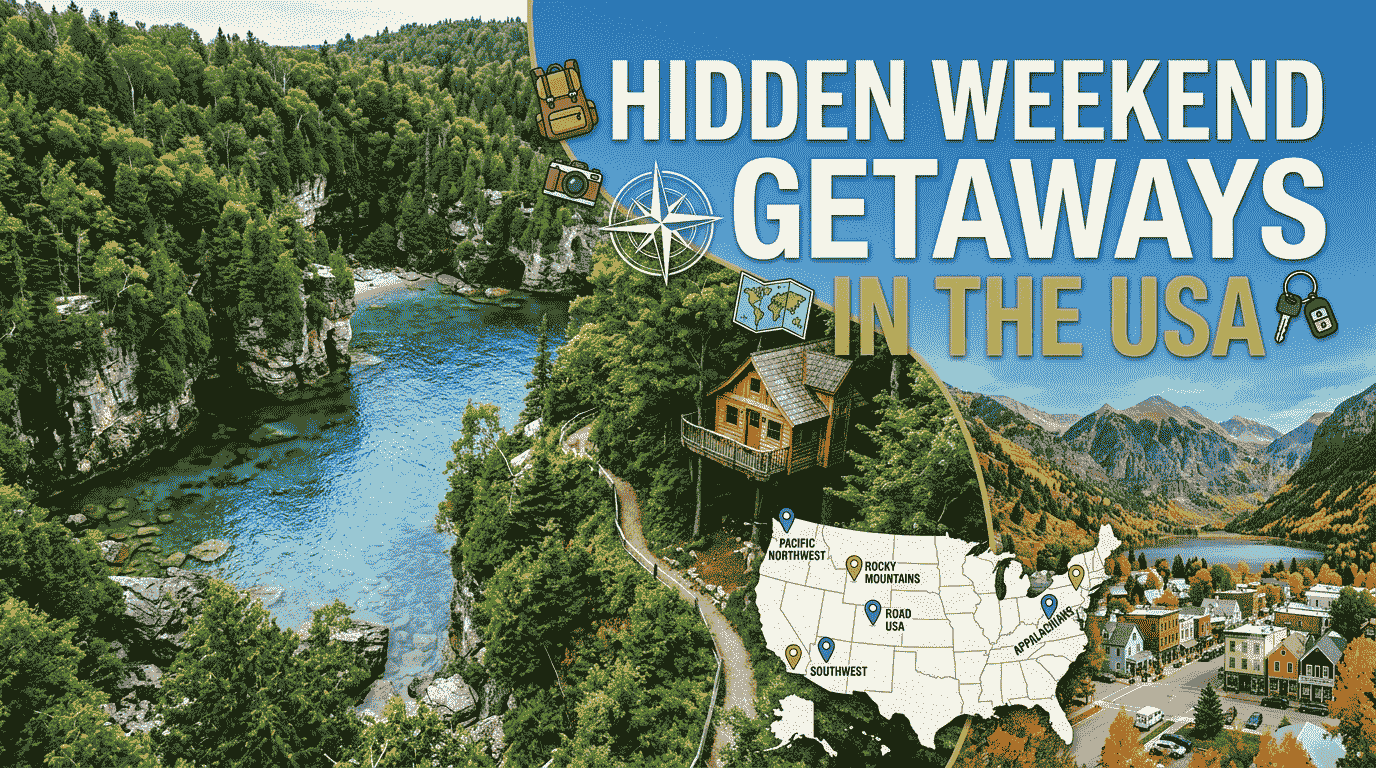
Hidden weekend getaways in the USA that aren’t secretly packed already — real small towns worth the drive, without the theme-park version of “hidden.”
Hidden Weekend Getaways in the USA
Every “hidden gem” list eventually recommends somewhere with a two-hour wait for brunch and a parking situation that ruins the whole point of going. That’s not hidden. That’s just popular with better marketing.
This is a shorter list, on purpose — places that are genuinely a little under-the-radar, easy to reach without three connecting flights, and worth the drive even if the weather doesn’t cooperate. Some of these you’ll recognize by name and just haven’t gotten around to. Others you’ve probably never heard of, which is sort of the point.
Galena, Illinois
Ninety minutes from the Quad Cities, tucked into rolling hills that don’t look like they belong in Illinois at all. Galena’s whole downtown is built into a hillside of 19th-century brick storefronts — the kind of place where the buildings are the attraction, not just the backdrop for one.
It’s a former lead-mining boomtown that never got the memo it was supposed to fade out, so the architecture stuck around almost entirely intact. Good for a weekend of wandering with no fixed plan — antique shops, a handful of solid restaurants, and hills steep enough that you’ll actually feel the walk.
Go in shoulder season, October especially. Summer weekends pull a decent crowd from Chicago, and part of what makes this place work is the quiet.
Eureka Springs, Arkansas
Built into the Ozark hills in a way that means almost nothing is flat — streets curve, buildings stack, and the whole town has a slightly disorienting, storybook quality to it. Victorian architecture, natural springs the town’s named after, and an arts scene that’s more genuine than performative.
It’s odd in a good way. Part historic spa town, part hippie holdout, part small-town Arkansas — those three things shouldn’t coexist as comfortably as they do here, but they do. Worth a full weekend just walking the switchback streets and letting the town’s weirdness do the work.
The Finger Lakes, New York (the smaller towns, not the wineries alone)
Everyone knows the Finger Lakes has wineries. Fewer people actually stop in towns like Aurora, Naples, or Hammondsport, which sit right on the water and don’t get the tour-bus traffic the bigger wine trail towns absorb.
Aurora specifically — tiny, lakeside, home to a well-preserved historic inn — feels like the region twenty years before it got discovered. Rent a cabin near one of the smaller lakes, spend the weekend on back roads between towns, and skip the wineries with the longest lines. The smaller, family-run ones pour the same quality without the wait.
Bisbee, Arizona
An old copper-mining town in the mountains near the Mexican border, built on impossibly steep streets that make you understand why cars weren’t really the plan when the town was laid out. It went from mining boomtown to near-ghost-town to artist colony over the course of a century, and all three eras are still visible if you look for them — mining relics, abandoned storefronts, and a genuinely active arts scene layered right on top of each other.
Cooler than the surrounding desert thanks to elevation, which matters more than people expect if you’re visiting in summer. A weekend here means a lot of walking uphill, some genuinely strange local history, and coffee shops that don’t feel staged for visitors.
Berkeley Springs, West Virginia
America’s first spa town, technically — George Washington reportedly soaked here, which the town mentions often enough that it’s basically part of the welcome sign. Small, low-key, built around natural mineral springs and a scattering of independent spas that range from rustic to genuinely upscale.
Close enough to DC and Baltimore for a weekend without much driving, far enough that it doesn’t feel like an extension of either city. Good pick specifically for a slower weekend — soaking, short hikes in the surrounding hills, and not much of an agenda beyond that.
Port Townsend, Washington
A Victorian seaport town on the Olympic Peninsula that boomed in the 1890s expecting to become a major West Coast port, didn’t, and ended up frozen in that architectural moment ever since. The result is a genuinely well-preserved 19th-century downtown facing directly onto the water, with the Olympic Mountains visible across the sound on a clear day.
It’s a ferry ride or a long drive from Seattle, which keeps the crowd smaller than the town’s charm probably deserves. Good for a weekend that mixes small-town wandering with real outdoor access — the peninsula’s trails and beaches are right there if you want them.
What Actually Makes a Getaway Feel “Hidden”
A few patterns worth knowing before you plan around any list like this one, including this one:
- Distance from a major highway matters more than distance from a city. A town 40 minutes off the interstate stays quieter than one 90 minutes away but sitting right on it.
- Off-peak timing does more work than obscurity. A well-known small town in shoulder season often feels quieter than a genuinely obscure one during its one busy weekend a year (often a local festival you won’t know about until you’re stuck in it).
- “Hidden” has a shelf life. Most of these towns get written about once, quietly, and then again, and again, until they’re not hidden anymore. Going sooner rather than later is generally the move.
FAQ
What makes a weekend getaway feel “hidden” rather than just small?
Distance from major highways, off-peak timing, and a lack of recent viral attention all matter more than a town’s actual size or obscurity.
Are hidden getaways cheaper than popular destinations?
Usually, yes — lodging and dining costs tend to track visitor volume more than a town’s quality, so lower-traffic towns often cost noticeably less.
When is the best time to visit lesser-known small towns?
Shoulder season — generally spring and fall — tends to offer the best mix of good weather and lower crowds compared to peak summer weekends.
Is it worth visiting Finger Lakes towns beyond the wineries?
Yes — towns like Aurora, Naples, and Hammondsport sit directly on the smaller lakes and see far less tour traffic than the main wine-trail towns.
How far in advance should I book a weekend getaway to a small town?
A few weeks is usually enough for smaller towns, though festival weekends or peak fall foliage periods can book up faster than expected.