
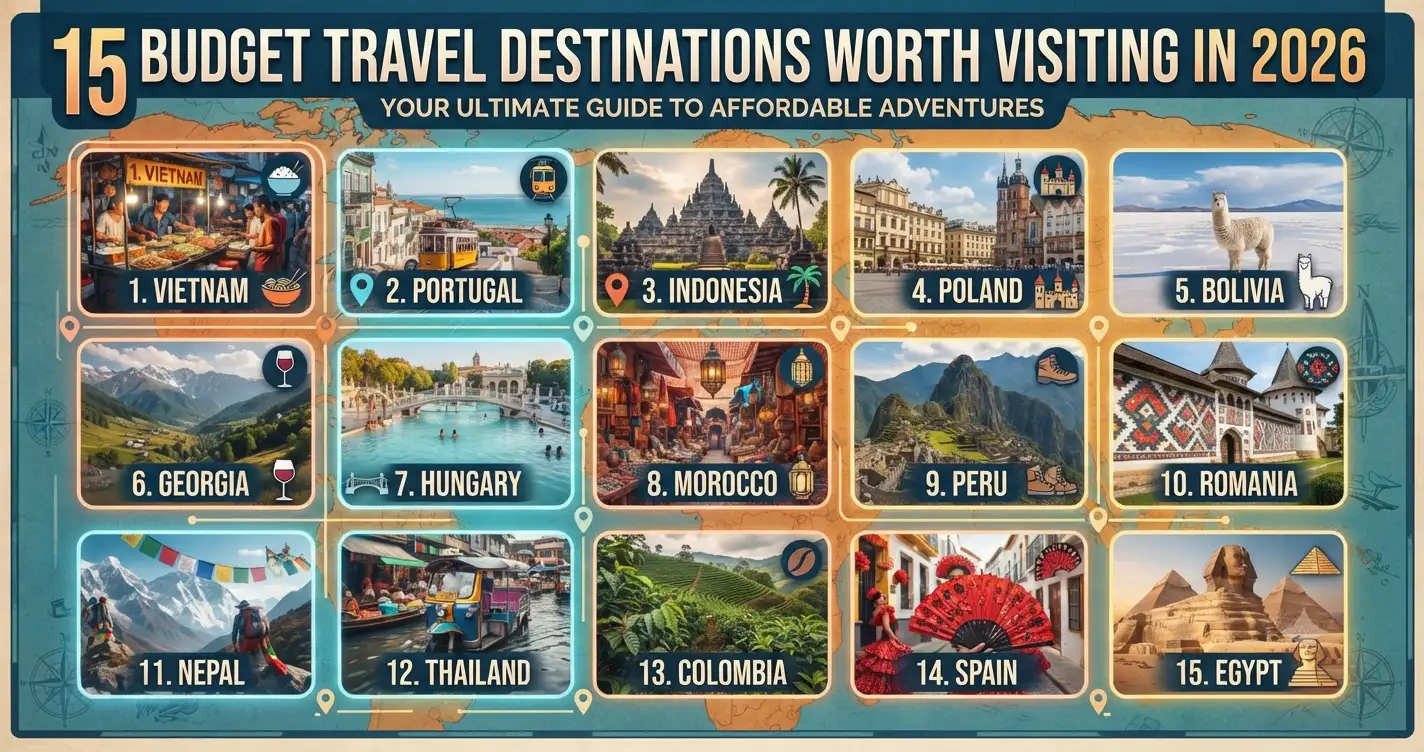
Flights got expensive, not travel itself. Here are 15 places in 2026 where the money still stretches — without the “hidden gem” clickbait.
15 Budget Travel Destinations Worth Visiting in 2026
The flight search tab has been open for forty minutes and every result still says $612, no matter how many incognito windows get opened out of superstition. That’s the part nobody warns you about with budget travel — it’s not that cheap trips don’t exist anymore, it’s that the obvious destinations everyone already knows about stopped being cheap around the same time everyone found out about them.
The places below still have room. Not because they’re secret — plenty of people already know about them — but because the exchange rate, the off-season timing, or the lack of a viral TikTok moment (yet) keeps costs down in a way that Lisbon or Bali stopped offering years ago.
Where the money goes furthest in Europe right now
1. Sarajevo, Bosnia and Herzegovina. Coffee culture that rivals Vienna at a third of the price, a old town that feels genuinely lived-in rather than staged for tourists, and a complicated, moving history documented in small museums that don’t charge much to enter. Winters get cold and grey, which is exactly why accommodation prices drop hard outside summer.
2. Plovdiv, Bulgaria. Older than Rome by most estimates, with a walkable old town of Roman ruins sitting casually next to modern cafes. A sit-down meal with wine still comes in well under what a fast-food combo costs in most of Western Europe.
3. Timișoara, Romania. Recently renovated squares, a genuinely good coffee and craft beer scene, and prices that stay low even in the tourist-friendly center. Less crowded than Bucharest, easier to navigate for a first-time visitor to Romania.
4. Porto, Portugal — specifically the outer neighborhoods. The riverside center has gotten pricier, but a fifteen-minute tram ride out puts a traveler in neighborhoods with the same tiled buildings and port wine at half the central price.
Southeast Asia, still doing what it’s always done
5. Battambang, Cambodia. Quieter than Siem Reap, still close enough for an easy day trip to Angkor Wat, with guesthouses running a fraction of what similar quality costs closer to the temples themselves.
6. Vang Vieng, Laos. The party-town reputation from a decade ago has mostly faded, replaced by karst limestone scenery, cheap guesthouses, and activities like kayaking and cave exploring that cost a few dollars rather than a few hundred.
7. Ipoh, Malaysia. Famous locally for food, barely known internationally as a destination in its own right. Colonial-era architecture, cave temples, and some of the least expensive quality meals anywhere in Southeast Asia.
8. Hoi An, Vietnam — during shoulder season. The lantern-lit old town gets busy and pricier in peak months, but visiting in the shoulder months around April or October keeps both the crowds and the prices down while the weather stays workable.
Latin America, where the exchange rate is doing a lot of the work
9. Guanajuato, Mexico. Colorful, hilly, full of alleyways and student-town energy from the local university, with prices that stay low even for travelers, not just backpackers scraping by on tortillas.
10. Salento, Colombia. Coffee farm country, colorful buildings, and a genuinely walkable town center — a fraction of what similar mountain-town charm costs in Europe or North America.
11. Cuenca, Ecuador. Popular with retirees for a reason — cost of living stays remarkably low, the historic center is genuinely beautiful, and it sits at an elevation that keeps the climate mild year-round.
12. Antigua, Guatemala. Volcano views, colonial architecture, and Spanish-language schools that make it a common stop for language learners on a budget, which keeps the local infrastructure geared toward longer, cheaper stays rather than short expensive ones.
Places that surprise people by being affordable
13. Tbilisi, Georgia (the country, not the state). A wine region older than most countries, a genuinely wild nightlife scene, and prices that still feel like a mistake compared to the quality of food and lodging on offer.
14. Kotor, Montenegro. Fjord-like scenery without the Norwegian price tag, a walled old town, and hikes with sweeping views that cost nothing but the effort of climbing.
15. Yerevan, Armenia. One of the oldest continuously inhabited cities in the world, with brandy that rivals cognac, mountain views of Ararat, and a cost of living that stays low even as flight connections slowly improve.
The part budget travel guides usually skip
Cheap flights and cheap destinations aren’t quite the same problem, and conflating them is where a lot of people overspend without realizing it. A $300 flight to an expensive city can cost more overall than a $700 flight to somewhere genuinely affordable once accommodation, food, and activities are factored in over a full trip.
Travel researchers, including groups like the World Tourism Organization, have pointed out that shoulder-season and off-peak travel consistently offers the biggest single cost reduction available to travelers — often more impactful than which destination gets picked at all. Shifting a trip by even three or four weeks outside a destination’s peak season routinely cuts accommodation costs by 30-40%, sometimes more.
Booking accommodation directly through a local guesthouse’s own website or messaging app, instead of through a booking platform, also tends to save money — platforms take a cut that many smaller properties are happy to skip if asked directly, especially outside peak season when they’re eager to fill rooms.
FAQ
What’s the cheapest region to travel in 2026?
Southeast Asia and parts of Eastern Europe and the Caucasus (Georgia, Armenia, Bosnia) currently offer some of the lowest costs relative to experience quality, though this shifts as exchange rates and popularity change.
Is it cheaper to book flights or accommodations first?
Generally flights, since flight prices swing more dramatically with timing and route flexibility. Once a destination and rough dates are set, accommodation searching should follow.
How far in advance should budget travel be booked?
For flights, roughly 2-4 months ahead for international trips tends to balance price and availability. For accommodation in budget-friendly destinations, even 2-3 weeks ahead is often fine since demand is lower than in saturated tourist hubs.
Does traveling in shoulder season actually save that much money?
Yes, often significantly — accommodation prices frequently drop 30-40% just outside a destination’s peak weeks, sometimes more in places with sharp seasonal tourism swings.